
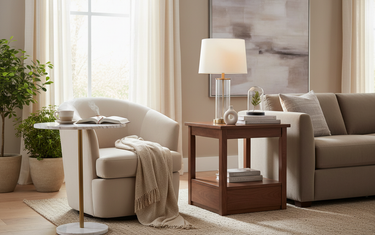
Most people use the terms side table and end table interchangeably, yet they are not the same, and that difference matters once you start planning a room layout. End tables are typically 22–30 inches high while side tables are 20–24 inches, and that small variation changes how comfortable and functional your seating area feels.
Furniture terminology is not always as tidy as the furniture itself. A side table vs end table is a good example. An end table is generally designed to sit at the end of a sofa or beside a chair and is typically 22–30 inches high, while a side table sita at 20–24 inches high and can move more freely around the room. There is overlap, but the distinction is useful.
The differences between the two become quite clearer once you stop looking at the names and start looking at proportion. Where will the table sit? How high is the sofa arm? Will it hold a lamp and a drink, or is it there mainly to give an empty corner some purpose? These details have a quiet effect on how settled a room feels.
That is particularly noticeable in styles where proportion does much of the work. A restrained side table can sit beautifully within Organic Modernism, for instance, while a more structured end table may feel at home in a Transitional scheme. Neither is inherently more formal or more decorative. Much comes down to the piece itself, and how convincingly it relates to everything around it.
Key Takeaways
| Question | Short Answer |
|---|---|
| 1. What is the main difference between a side table and an end table? | End tables usually sit at the ends of sofas, are taller and wider, and often used in pairs. Side tables are slightly lower, more compact accents that can move between corners, beside chairs, or next to a bed. |
| 2. Where should I use a side table vs an end table in my living room? | Use end tables at each end of a sofa or sectional for lamps and everyday items. Use side tables beside armchairs, floating between seats, or to anchor a reading nook. Explore our curated Side Tables collection for ideas. |
| 3. Are marble side tables suitable as end tables? | Yes, as long as height and width match your sofa arm. Many marble designs work beautifully in end-table positions. Our dedicated Marble Side Tables collection is designed with this versatility in mind. |
| 4. Which is more flexible if I like to change my layout often? | Side tables are generally smaller, lighter, and more sculptural, so they adapt better when you rearrange your furniture or move between rooms. |
| 5. Is there a price difference between side tables and end tables? | End tables are often sold in pairs and fall in a moderate to high price range, while side tables are usually sold individually and can be a more accessible way to introduce luxury materials like marble. |
| 6. Can a side table work as a nightstand? | Yes, especially in modern interiors that favor lighter silhouettes over bulky storage. Look for diameters around 40–55 cm and heights close to your mattress. |
| 7. Which should I choose for a small apartment? | A well-chosen side table offers more flexibility and visual lightness than most end tables, which is ideal for compact spaces where every piece must work hard both functionally and aesthetically. |
Side Table Vs. End Table Comparison Table
|
Question |
End Table |
Side Table |
|
What is the main difference between a side table and an end table? |
Primarily intended for the end of a sofa, sectional, or beside a chair, with everyday use in mind. |
A more flexible small table that can sit beside seating, in a corner, beside a bed, or in another open spot. |
|
Where should you place an end table? |
Most naturally at the end of a sofa or sectional, where it keeps drinks, books, lamps, and other essentials within reach. |
Beside an armchair, lounge chair, sofa, between seats, or wherever a compact surface is useful. |
|
What is a side table used for? |
Mainly for practical support within a seating arrangement. |
Both practical and decorative, from holding a drink or book to giving a corner or reading area some visual interest. |
|
What is an end table used for? |
Everyday essentials such as a lamp, drink, remote, or book, often positioned close to arm height for easy access. |
The same everyday uses are possible, but the table may have a more decorative or flexible role. |
|
Side table vs end table height: which is taller? |
In our experience, end tables commonly fall within 22–30 inches, depending on the seating they accompany. |
Our side tables commonly fall within 20–24 inches, although the individual design and surrounding furniture matter. |
|
Can a side table be used as an end table? |
Yes, provided its height, footprint, and proportions work with the sofa or chair. |
Yes. A side table can take on an end-table role when its scale makes sense beside the seating. |
|
Which works better in a small living room? |
A compact end table can make use of the narrow space beside a sofa without adding much visual bulk. |
A side table can offer more freedom when floor space is limited or the layout changes frequently. |
|
Are side tables and end tables the same? |
Not always. The terms overlap in everyday use, but “end table” usually describes its position in relation to seating. |
The term is broader, often referring to a small table that can be used in several locations around a home. |
|
Do you need an end table on both sides of a sofa? |
No. A single table can work perfectly well, especially where the layout or available floor space does not allow for two. |
No. Side tables are generally used as individual pieces, so there is no requirement for a matching pair. |
|
Which should you choose? |
Choose an end table when you need a practical surface closely tied to a sofa or chair. |
Choose a side table when placement, shape, or styling flexibility matters more to you. |
Side Table vs End Table: Definitions And Why The Distinction Matters
From our perspective as furniture makers, the difference between a side table and an end table starts with intention. End tables are designed as functional partners to your sofa, while side tables serve as versatile accents that move more freely around the room.
In practice, both types can overlap, but understanding their typical roles helps you choose proportions correctly and avoid pieces that feel either too large or too small once placed.
What Is An End Table?
An end table usually sits at the end of a sofa, sectional, or large armchair. It is traditionally used to support table lamps, books, or everyday items like remotes and drinks.
End tables tend to be closer to arm height, usually 22–30 inches, so that you can reach everything comfortably without leaning down.
Their purpose is straightforward, but their position is quite deliberate. At the end of a sofa, an end table adds a useful surface without interrupting the space in front of it.
It can hold a lamp that brings light down to the seating level, keep a drink close at hand, or simply give the sofa a more finished appearance.
They work particularly well when the surrounding furniture has a clear sense of proportion. A substantial sectional may call for a more grounded table, while a lighter armchair can take a smaller, more refined piece.
An end table does not necessarily need to be part of a matching pair either. One well-placed table can be all a room needs
What Is A Side Table?
A side table is slightly lower and more flexible in use. You can position it beside a lounge chair, between two armchairs, in a corner, or even as a compact bedside solution.
Side tables are commonly 20–24 inches high and, in many luxury homes, act almost like small sculptures that also happen to hold your coffee or a favorite book.
That versatility is what makes a side table useful beyond the main seating arrangement. One might sit beside a reading chair with a lamp and a stack of books, while another could fill a quiet corner with a vase or a small object.
In a bedroom, the same idea can work beside the bed when a full-sized nightstand would feel too heavy.
There is also more freedom in how a side table looks. Round, square, pared-back, or sculptural, it can complement the furniture around it without having to match everything else.
A marble side table with pronounced veining, for instance, can hold its own as a small design feature while still doing a very ordinary job.
Why It Matters In A Luxury Interior?
The right choice affects comfort, scale, and how your room feels around you when you sit down. In refined spaces, a few centimeters in height or a few centimeters in diameter can be the difference between harmonious and awkward.
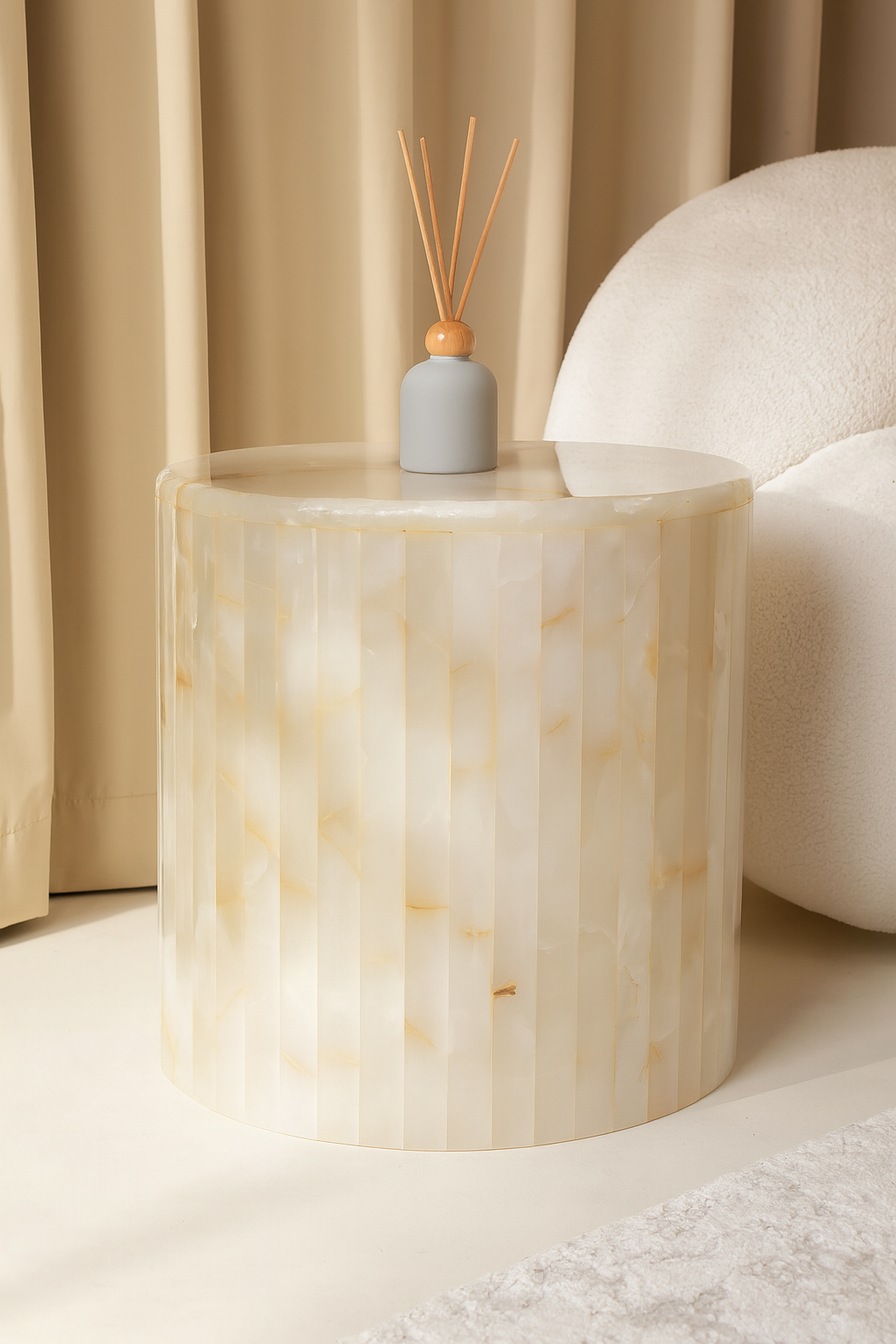
That is why we obsess over measurements like Dia 45 cm H 35 cm on a piece such as our Nira Onyx design, and this level of precision is equally important when deciding whether you need a side table or an end table.
 |
 |
Height And Proportion: How To Size A Side Table vs An End Table
Height is where many interiors go wrong. If a table is too tall, it overwhelms the seating, and if it is too low, you keep reaching down in an uncomfortable way.
End tables are typically 22–30 inches high, designed to sit close to or slightly below the arm of your sofa. Side tables are usually 20–24 inches, which works beautifully next to lounge chairs or as accent pieces that do not compete with other furniture.
Practical Height Guidelines
- End table height: close to sofa arm height, often 55–76 cm.
- Side table height: close to seat height, often 45–60 cm.
- Visual rule: top should sit level with, or up to 5 cm below, the arm of the seating piece.
Our Nira Onyx Marble Side Table, at Dia 45 cm H 35 cm, is deliberately low and sculptural. It works as a side table beside a low modular sofa, but you would not usually pair that height with a classic, high-armed sofa where an end table is more appropriate.
Choose taller tables when you want lighting and storage at hand near a sofa end, and choose slightly lower, compact tables when you want a flexible accent that can move around the room.
 |
 |
Shape, Surface Space, And Storage: Which Suits Your Lifestyle?
Beyond height, the second big difference in the side table vs end table conversation is usable surface. End tables often have a larger top and sometimes shelves or drawers.
Side tables usually have a smaller, cleaner top, more in line with how we view them: a place for a drink, a candle, or a book rather than a storage hub.
Typical End Table Characteristics
- Larger surface area for lamps plus personal items.
- Often rectangular or square, which suits the ends of sofas.
- Frequently designed as pairs for symmetrical layouts.
Typical Side Table Characteristics
- Smaller, often circular tops, perfect for a single setting.
- More sculptural bases, as seen in onyx, serpeggiante, or volakas marble designs.
- Used singly, floated between seats, or layered with coffee tables.
End tables tend to offer more storage, while side tables prioritize aesthetics and flexibility. If you prefer minimal clutter and refined materials, a side table is usually the better choice.

Explore four key differences between side tables and end tables. This infographic helps you choose the right piece for your space.
Placement: Where Side Tables And End Tables Work Best
End tables are designed for very specific positions. They sit neatly at each end of a sofa or sectional, framing the seating and creating a balanced composition.
This placement gives you symmetry, clear lamp positions, and a defined area for everyday items around the main seating piece.
Best Uses For End Tables
- Either side of a 3-seater or L-shaped sofa.
- At the outer edges of a pair of facing sofas.
- As a small anchor for a floor lamp in a corner of a large room.
Side tables are more relaxed in how they are used. You can place one between two occasional chairs, tuck one beside a chaise, or use one near a window seat.
They are particularly useful in apartments or open-plan spaces where you need small, flexible surfaces wherever people choose to sit.
 |
 |
Design And Materials: Why Marble Side Tables Stand Out
When we talk about side tables in a luxury context, marble is one of the most requested materials. It brings weight, permanence, and subtle movement through veining.
End tables can, of course, be crafted in marble, but side tables are where marble truly shines as a focal point, because they are often placed where the eye naturally rests.
Our Approach To Marble Side Tables
At Art Dei Marmi, we work with onyx, serpeggiante, beige marble, and volakas finishes. Each type has its own character, from soft linear veining to more dramatic movement.
Side tables such as the Nira Onyx Marble Side Table or Callaia Serpeggiante Marble Side Table are made as sculptural pieces first, with function built in through proportion and balance.
Material Considerations For Everyday Use
- Marble is timeless and, with the right care, will last generations.
- It is also porous, so we recommend coasters for drinks and gentle cleaning products.
- Heavier marble pieces are ideal as side tables that stay in place, while lighter combinations like marble tops with wooden bases work where you move pieces more often.
Whether you use them as end tables beside a sofa or as pure side tables next to a lounge chair, marble designs instantly raise the perceived quality of the entire room.
Budget And Value: Cost Differences Between Side Tables And End Tables
Side tables and end tables do not just differ in shape or placement. They also tend to behave differently when it comes to pricing and how you buy them.
End tables are often sold in pairs and fall into a moderate to high price range because you are purchasing two coordinated pieces at once.
How Side Tables Fit Your Budget?
Side tables are usually sold individually. This gives you flexibility, because you can invest gradually, add one sculptural piece to a room, and then decide later if you want a second or a completely different design on the other side.
For example, our Daro Teakwood Marble Side Table, with a marble top and teakwood base, is priced at 680 Dhs., while the more intricate Nira Onyx Marble Side Table is 6400 Dhs., reflecting the rarity and craftsmanship of the onyx finish.
Typical Price Considerations
- End tables: higher combined investment, usually bought as symmetrical pairs.
- Side tables: price per piece, ideal for curated, non-matching layouts.
- Marble: higher initial cost, but exceptional longevity and timeless appeal.
If you are building a space slowly, side tables are an excellent way to introduce premium materials and craftsmanship without committing to a full pair immediately.
Styling Ideas: How To Use Side Tables vs End Tables In Different Rooms
Once you understand the functional difference, the next step is styling. End tables naturally support balanced, symmetrical arrangements.
Place a matching pair on either side of a sofa, add twin lamps, and you instantly create a calm and ordered focal point.
Styling Side Tables In A Living Room
- Use a single marble side table beside an accent chair as a reading spot.
- Float a compact round side table between two occasional chairs for intimate conversation.
- Layer a low, sculptural side table in front of a sofa, slightly overlapping with a coffee table.
In bedrooms, a side table can replace a bulky nightstand, especially in smaller spaces. Its light footprint keeps the room feeling open, while marble or fine wood adds a sense of quiet luxury.
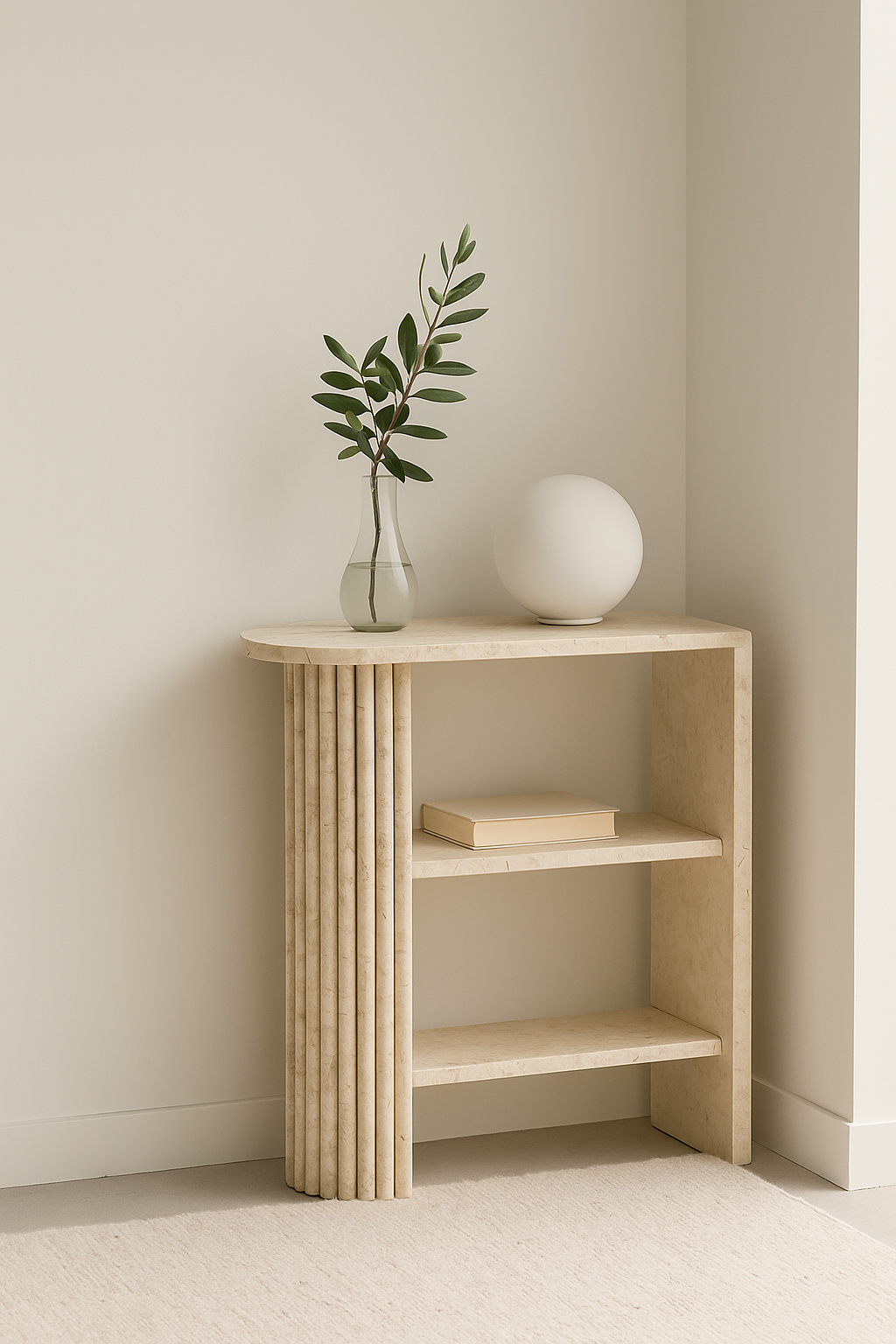
In entryways or corridors, smaller corner-friendly pieces, like the Dina Beige Marble Corner Console Table, can act either as a side table or an improvised end table depending on what you pair them with.
Choosing Between Side Table And End Table: A Simple Comparison Table
If you are still not sure which one you need, it helps to see the differences side by side. Use the comparison below as a quick decision tool while measuring your space.
Think about how you sit, what you reach for, and whether you prefer formal symmetry or a more curated, collected look.
| Feature | End Table | Side Table |
|---|---|---|
| Typical Height | 22–30 inches (approx. 55–76 cm) | 20–24 inches (approx. 50–61 cm) |
| Position | At the ends of sofas and sectionals | Beside chairs, between seats, in corners |
| Surface Space | Larger, more storage-friendly | Smaller, more minimal |
| Usual Purchase | Often in pairs | Usually single pieces |
| Best For | Formal seating layouts, lamps, daily essentials | Accents, flexible layouts, sculptural statements |
As a rule, if you want symmetry around a sofa, think end tables. If you want flexibility, visual lightness, and a touch of artistry, think side tables.
Many of our clients combine both, using more structured end tables around the main sofa and more expressive marble side tables around accent seating.
 |
 |
Real Examples From Our Collection: How Side Tables Behave In Practice
To make the difference more concrete, it helps to look at specific pieces and imagine them as side tables or in an end-table role. Each of our designs is carefully dimensioned for real spaces.
Here are a few examples and how we see them used in interiors.
Nira Onyx Marble Side Table – Sculptural Accent
With a diameter of 45 cm and a height of 35 cm, the Nira Onyx Marble Side Table is ideal beside a low modular sofa or a lounge chair. It reads as a piece of art that also holds a drink or a book.
At 6400 Dhs., it is a statement side table, and you would rarely buy two to use as traditional end tables. Instead, it becomes a focal point in one or two carefully chosen spots.
Daro Teakwood Marble Side Table – Versatile All-Rounder
The Daro Teakwood Marble Side Table, Dia 55 cm H 40 cm at 680 Dhs., has a generous round top with a solid teakwood base. It can act as a side table beside a chair, or as a single end table at the side of a compact sofa.
Its proportions and material mix make it one of those rare pieces that move gracefully between roles depending on where you place it.
How To Measure Your Space For The Perfect Side Or End Table?
Before you decide whether you need a side table or an end table, measure everything around it. Good measurements make online selection easier and reduce surprises on delivery day.
We always encourage clients to take three key measurements around each seating piece.
Essential Measurements
- Seat height and arm height of your sofa or chair.
- Available width beside the seating for a table footprint.
- Distance to other furniture like coffee or dining tables.
With these, you can quickly see if an end table height will match your sofa arm or if a lower side table will feel more natural. You also avoid crowding if you already have a generous coffee table nearby.
Remember that side tables can break rules more easily. If you love a particular marble piece but it is slightly lower than usual, you might still choose it as a relaxed side table, just not as a formal end table.
 |
 |
Conclusion
Side table vs end table is not just a question of language. It is about how you live in your space, how you sit, and what you reach for when you relax.
End tables are taller, more structured, and usually come in pairs at the ends of sofas. Side tables are slightly lower, more flexible, and often express more personality through material and form.
From the compact elegance of the Elara Volacas Marble Top Side Table at 690 Dhs. to the sculptural presence of the Nira Onyx Marble Side Table at 6400 Dhs., our side tables are crafted to work beautifully in both roles when proportions are right.
If you measure carefully, consider how you use each seat, and choose materials that you enjoy living with every day, both side tables and end tables become quiet, dependable pieces that support the way you live while adding refinement to every corner of your home.