
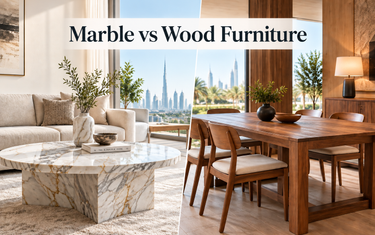
Choosing between marble and wood furniture is not simply a matter of which material looks better. For anyone considering furniture buying in the UAE, the right choice also depends on how the material fits your space, lifestyle, and everyday use, as well as how it responds to indoor temperatures, humidity, strong sunlight, spills, and scratches.
Marble furniture is often chosen for its natural veining, solid feel, and striking appearance, making it particularly appealing for dining tables, coffee tables, and statement pieces. Wood brings a different character to a room. It feels warmer, comes in a wide range of finishes, and can often be repaired or refinished as it ages.
So, is marble or wood better for a UAE home? There is no single winner for every space. Marble can be a better choice when you want a distinctive statement piece with a refined finish, while solid wood may suit homes where practicality, easier movement, and long term repairability matter more.
This marble vs wood furniture guide compares both materials based on the factors that can influence your buying decision in the UAE. We will look at durability, maintenance, heat and humidity, stains and scratches, design, cost, weight, and everyday use, helping you decide which material makes more sense for your home and lifestyle.
Marble vs Wood: What Matters Before You Buy
|
Question |
Quick Answer |
|
Which looks more luxurious? |
Marble tends to have more presence. The veining is natural, so each slab has its own look. |
|
Which feels warmer? |
Wood usually feels more relaxed. Its grain and colour bring a softer look to the room. |
|
Which is easier to move? |
Wood. Marble pieces can get surprisingly heavy, especially larger ones. |
|
Which requires more careful stain management? |
Marble needs quicker attention. Wipe up spills rather than letting them sit, especially acidic ones. |
|
Which can be refinished more easily? |
Solid wood. Depending on the finish, you can often sand away surface wear and refinish it. |
|
Which works best for UAE homes? |
Both can work well indoors. The better choice depends on the room, sunlight, humidity, and how the furniture will be used. |
|
Which lasts longer? |
Both can last for decades. The build quality and care will usually matter more than choosing one material over the other. |
What is Marble Furniture?
Marble furniture is any furniture using natural marble, a metamorphic stone, as part of its construction. Most often, you'll see it on the top of a table. But that's not the only way it can be used.
Marble itself is formed from limestone under heat and pressure. Its mineral content is what gives it those natural colours, lines and veining. And because the pattern comes from the stone itself, two slabs of the same marble can look noticeably different.
-
Finishes
Marble furniture comes in two common finishes. Polished and honed. Polished marble has a glossy surface that reflects light, making the veining more noticeable. Honed marble is smooth but matte. These stones look softer and less reflective.
-
How Is Marble Used in Furniture?
There are a few ways marble shows up in furniture. It can be the tabletop, the base, or the main material in a full-stone piece. It is also often combined with wood or metal, rather than used on its own. And sometimes that combination makes more sense than choosing either material on its own.
You'll commonly find it in dining tables, coffee tables, side tables, console tables, and desks.
Must Ready this Guide before Furniture Buying in UAE: Luxury Furniture Buying Guide for UAE Homes
What is Wood Furniture?
Wood furniture uses natural timber or wood-based materials as part of its construction. Wooden furniture usually refers to pieces made from solid oak, walnut or teak. But could also mean the finished product is made from plywood, MDF or another engineered wood.
-
Understanding Different Types Of Wood
The label “wood” doesn't tell you the whole story. Oak, walnut, teak, plywood and MDF can all end up in furniture, but they don't behave the same way. That becomes even more relevant in UAE homes, where heat, humidity and strong air-conditioning can affect how materials perform over time.
Solid Wood
Solid wood means the piece is made from natural wood rather than a wood-based composite. Oak, walnut and teak are common examples used in furniture.
Hardwood
Hardwood is a separate classification. It refers to wood from broad-leaved trees. Many hardwoods are commonly chosen for furniture because of their strength and durability. Oak and walnut are good examples.
Engineered Wood
Engineered wood takes natural wood and turns it into something new. Depending on the product, that can mean fibres, particles, veneers or thin layers bonded together to form a board. Plywood, MDF and particleboard are common examples.
Now It’s important to note that engineered wood doesn’t automatically mean poor quality. Some engineered boards are made to a high standard and can work very well in furniture.
The difference is in the material and construction, not simply in whether it is “engineered” or “solid.”
Surface Finish
Wood furniture is usually finished after it is made. That final layer helps protect the surface and can also change the way the wood looks. You might see oil, wax, varnish, or lacquer, depending on the piece.
Marble vs Wood Furniture: Quick Comparison
|
Factor |
Marble |
Wood |
|
Appearance |
Veining gives it a strong, distinctive look. |
Grain gives it a more natural, understated character. |
|
Natural variation |
No two slabs will have exactly the same veining. |
Grain and colour can vary, even within the same wood species. |
|
Durability |
Hard-wearing, but it can still chip, scratch or etch. |
Can be very durable, especially solid hardwood. But dents and scratches are possible. |
|
Scratch sensitivity |
Less prone to everyday scratching, but not scratch-proof. |
More likely to show scratches or dents, depending on the wood and finish. |
|
Stain sensitivity |
Spills should be wiped up quickly, especially acidic ones. |
A good finish offers protection, but spills shouldn't be left sitting on the surface. |
|
Moisture |
Sealing helps protect the surface, but marble can still absorb liquids. |
Wood naturally responds to moisture and humidity, which can cause movement over time. |
|
Heat |
Handles normal household heat well, but sudden temperature changes can be an issue. |
Hot objects can mark the finish or damage the surface. |
|
Weight |
Heavy, particularly with large slabs and stone bases. |
Usually easier to lift, move and rearrange. |
|
Maintenance |
Needs sensible cleaning and occasional stone care. |
Usually simple, but the right care depends on the finish. |
|
Repairability |
Chips and etching can often be repaired or polished. |
Solid wood can often be sanded, repaired and refinished. |
|
Customisation |
Choice of stone, veining, shape, edge and base. |
Many options in species, stain, finish, shape and construction. |
|
Style versatility |
Particularly suited to contemporary and statement interiors. |
Works across a much wider range of interior styles. |
|
Cost |
Depends heavily on the marble, slab, size and craftsmanship. |
Can range from relatively affordable engineered wood to premium solid hardwood. |
|
Long-term ownership |
Can stay beautiful for decades with proper care. |
Quality solid wood can also last for decades and can often be renewed along the way. |
|
Best suited for |
Someone who wants natural stone and a stronger visual impact. |
Someone who wants natural grain, easier movement, and the option to refinish. |
Marble or Wood: Which Fits Your Home Better?
At first glance, the choice can seem pretty simple. Marble has the veining and presence. Wood has grain and warmth. Pretty easy to choose, right?
Actually, no. Once you start living with the furniture, the differences become more practical. Details like scratches, stains, weight, and maintenance as per the UAE climate can surface. Even things like how easily furniture can be repaired start to matter too.
That’s exactly where marble and wood begin to feel quite different.
-
Appearance & Aesthetics
Marble tends to draw the eye. Its veining, colour shifts and natural patterns are part of the stone itself. So even two slabs of the same marble can look quite different.
It tends to suit people who like a cleaner, more contemporary look. It’s also for people who want the furniture to make more of a statement.
Wood is more about grain, tone and texture. Oak, walnut and teak each have their own character. And even pieces made from the same species can look different.
It works well when you want the furniture to feel warmer and more settled into the room.
-
Durability and Longevity
In the durability debate of marble and wood, neither material gets a free pass here. Marble can stay in good condition for years, but its durability isn't just about how hard the stone is. Some marbles are more vulnerable to scratching or etching than others because their mineral composition and finish differ. A polished surface, for example, can show etching more clearly than a honed one.
Then there is the furniture itself. A thick, properly supported marble top is a different proposition from a thin slab sitting on a poorly designed base. Sealing helps with staining, too, but it won't stop acidic spills from etching the stone.
Wood is just as dependent on the details. Species, construction, joinery, finish, and moisture exposure all affect how well a piece holds up. A well-built solid hardwood table with a suitable finish can perform very differently from a lower-quality engineered-wood piece.
-
Maintenance
In terms of maintenance, both marble and wooden furniture are fairly easy to live with. The upkeep just looks different. Marble usually needs a little more than regular cleaning with a stone-safe product. Some types also need resealing from time to time.
Wood depends more on its finish. A sealed surface is simple to wipe down. Oiled wood may need a little more attention as it ages.
There is another difference worth knowing. Solid wood can often be sanded and refinished when the surface starts looking worn. Marble doesn't offer quite the same option. Surface damage may need polishing. In some cases, professional restoration might be needed instead.
-
Weight & Moving Furniture
This is a difference you notice pretty quickly. Marble is dense, and a large stone top can be surprisingly heavy. A single slab can weigh hundreds of kilograms, depending on its size and thickness.
That matters when the furniture has to get into your home. In an apartment, lifts, staircases, doorways and tight corners can all become part of the delivery plan. Villas have their own challenges, particularly when a large piece needs to go upstairs.
Wood is much easier in this respect. It is generally lighter and easier to reposition. If you like changing your layout or expect to move house at some point, that flexibility can be a real advantage.
-
Repair and Restoration
A scratch or small chip does not automatically mean the end of a marble piece. Light scratches and dull areas can often be polished. Similarly, smaller chips can be filled and repaired. Cracks are more complicated though, and the repair will depend on their size and location.
Wood gives you a little more room for error. With solid wood, worn areas and scratches can usually be sanded and refinished. Small dents may only need a touch-up. More serious damage can require the whole surface to be refinished.
-
Cost & Long-Term Value
There is a wide price range for both marble and wood furniture in the UAE. The final cost depends on much more than the material itself. Marble type, thickness, wood species, construction, finish, size and craftsmanship all come into play. Custom work can push the price higher for either.
Marble vs Wood: Which Works Better for Different Furniture Types?
The material that works best for one piece may not be the right choice for another. Once you look at furniture by function, the marble-versus-wood decision becomes much easier to narrow down.
|
Furniture Type |
Marble |
Wood |
|
Dining table |
A strong option for formal dining and frequent entertaining. Consider the type of marble, finish, sealing, and how quickly spills can be dealt with. |
A practical choice for everyday family dining. The species, construction and finish will have a big impact on how it performs over time. |
|
Coffee table |
Works well when you want the tabletop to become a key part of the room. Consider the size and thickness of the stone in relation to the space. |
Gives you more flexibility when choosing shapes, sizes and finishes, particularly in smaller or frequently rearranged spaces. |
|
Console table |
A good fit for entrances, living rooms and other areas where the piece is more decorative than heavily used. |
Offers plenty of options in terms of species, finish and design, making it easier to coordinate with existing furniture. |
|
Side table |
Works best when the table has a defined place and doesn't need to be moved frequently. |
A practical option for pieces that may be shifted between seating areas or used for different purposes. |
|
Desk |
Suitable for a fixed home office where the surface and design are the priority. Make sure the dimensions and stone thickness work for the intended setup. |
Often more adaptable for everyday work, with a wider choice of dimensions, finishes and construction styles. |
|
Large villa dining table |
A large slab can suit a spacious dining area particularly well. Before ordering, check room proportions, access points and installation requirements. |
Can achieve a substantial look without making the same demands on delivery and installation. The construction becomes especially important at larger sizes. |
|
Apartment furniture |
Can work beautifully in an apartment, but check lift dimensions, doorways, and delivery access before choosing a large or solid piece. |
Offers more flexibility when working with tighter access points or a layout that may change later. |
For dining tables specifically, the choice deserves a closer look because daily use, maintenance, household habits and the type of marble or wood can all change the equation. You can explore that comparison in more detail in our expert marble vs wood dining table guide.
Marble vs Wood Furniture for the UAE Climate
Marble handles Dubai's heat well, but that does not make it completely unaffected by its surroundings. Strong sunlight can alter some finishes and colours over time. Sudden temperature changes can also matter. A piece sitting right beside a sunny window may need more attention than one placed elsewhere. Regular cleaning and suitable sealing help protect the surface.
Wood needs a different kind of care. Natural wood responds to changes in temperature and humidity, and UAE homes can experience plenty of both when outdoor heat meets heavy air conditioning. Over time, that movement can contribute to gaps, warping, or cracks, especially in poorly finished furniture. Direct sunlight, AC vents, and damp areas are best avoided.
Marble Vs Wood By Lifestyle
The way you live can be just as important as the look you are after. Someone furnishing a formal villa may want something very different from someone furnishing a smaller Dubai apartment. And if you move furniture around often, that changes the equation again.
Rather than choosing based on appearance alone, think about how the furniture will fit into your everyday life.
|
Buyer Type |
Better Starting Point |
Why |
|
Luxury-focused interior |
Marble |
Brings a polished, high-end feel to the space. |
|
Warm/minimal interior |
Wood |
Adds softness without overwhelming the room. |
|
Statement-piece buyer |
Marble |
Strong veining and bold forms naturally draw attention. |
|
Frequently rearranges furniture |
Wood |
Usually lighter and manageable. Less demanding to handle as well. |
|
Wants natural variation |
Both |
Marble has a unique veining. Wood has its own grain and tone. |
|
Wants easier refinishing |
Solid wood |
Can often be sanded and refinished as it ages. |
|
Stone-led contemporary design |
Marble |
Works naturally with clean, modern interiors. |
|
Mixed-material interiors |
Marble + Wood |
Combining both can balance warmth with a more refined look. |
When Should You Choose Marble Furniture?
So, when does marble actually make sense? Marble is an ideal choice when you want a piece of furniture to stand out without filling the room with decoration. A large marble coffee table can give an open-plan living room a strong centre. A dining table can do the same in a spacious dining area.
Marble is easier to appreciate when the rest of the room is relatively restrained. Think simple upholstery, warm wood, soft fabrics and uncomplicated lighting. Give the stone some breathing room. If there is already a lot happening in the room, heavily veined marble can tip it over the edge.
Then there is the stone itself. Natural marble is never completely uniform. The veining and colour will vary from slab to slab. If that is part of what you like about it, it is a major advantage. If you want every surface to look identical, marble may not be what you are after.
There is one practical consideration too. Marble suits people who are happy to give their furniture some basic care. It can last for years, but it is not a completely worry-free surface.
When Should You Choose Wood Furniture?
Wood is a good choice when you want a room to feel cozy and relaxed. Its natural grain adds character without demanding attention.
It also suits homes where furniture gets moved around. Solid wood is easier to handle than heavy stone. More importantly, it can often be sanded and refinished when the surface starts to show wear.
Wood works especially well with neutral colours, natural fabrics and softer textures. It is also a better fit if you want the furniture to blend into the room rather than become its main feature.
Should You Combine Marble and Wood Furniture?
In one word? Absolutely yes! Marble and wood both have very different personalities. But that is exactly what makes the combination interesting.
Marble has a cooler, smoother look. Wood brings a more tactile feel. That difference creates contrast without needing extra decoration. A marble top with a wooden base is an easy example, but you can also mix wooden furniture with smaller marble pieces around the room.
The key is balance. If you have a heavily veined marble piece, keep the wood fairly simple. If the wood has a strong grain, a quieter marble can work better with it. This keeps the textures interesting without making the room feel busy.
Mixed materials also give you more freedom when choosing furniture. You can bring in marble where you want a little more polish and use wood where the room needs a subtle organic character. In a custom piece, you can take that idea even further by choosing the stone, wood, and finish together.
Final Decision: Marble or Wood?
So, which one should you actually choose? Well, it really comes down to the role you want the furniture to play in your home. Go for marble if you want a stronger visual presence, natural stone character, and a more polished feel. Wood makes more sense if character, natural grain, and a softer look matter more to you. And if you like both, there is no reason to pick just one. Marble and wood can work beautifully together.
The decision ultimately comes down to the piece, its location, and how much use it will get. It also depends on how much maintenance you're comfortable with. In the end, there is no universal winner. The best choice is the one that fits your space and the way you live in it.
Frequently Asked Questions
-
Is marble furniture better than wood?
Not really. They simply do different things well. Marble gives you a hard, substantial surface and a more formal look. Wood feels warmer and is easier to repair or change over time. The better option depends on the furniture, how you use it and what matters most to you.
-
Is marble furniture more durable than wood?
Not across the board. Marble won't react to humidity the way natural wood does, but it can still chip, scratch or etch. Wood is more likely to pick up dents and surface marks, but solid wood can usually be sanded and refinished. In both cases, good construction makes a big difference.
-
Is marble or wood furniture more expensive?
There isn't a simple answer. A common marble can cost less than premium walnut, while a rare marble can cost far more than an ordinary wood species. Size, thickness, craftsmanship, construction and finishing also affect the price. Custom furniture can push either material into a higher price range.
-
Is marble furniture good for UAE homes?
Yes, particularly indoors. Marble itself isn't a problem in the UAE heat. The bigger concerns are direct UV exposure, sunlight, spills and the finish used on the stone. A well-made piece in the right location can work perfectly well in a Dubai home.
-
Does marble furniture require a lot of maintenance?
No, but you do need to be sensible with it. Wipe spills rather than leaving them sitting on the surface. And avoid acidic or abrasive cleaners. Sealing can also help with stain resistance.
-
Does wooden furniture get affected by humidity?
Yes. Timber naturally responds to changes in moisture by expanding and contracting. Large swings can eventually lead to gaps, cracking or warping, particularly in poorly made furniture. Keeping indoor conditions reasonably stable can reduce the risk.
-
Which is better for a dining table: marble or wood?
It depends on your household. Marble gives your luxury interiors a substantial, polished surface. But acidic foods and drinks can etch some types of marble. Wood is generally more forgiving and can be refinished when it starts looking tired.
-
Which is better for a coffee table: marble or wood?
For statement furniture, marble can give a coffee table real presence. It works especially well in a spacious Dubai apartment or villa. Wood brings more sense of calmess through its natural grain. It suits softer, more relaxed interiors. If you like both, try a marble top with a wooden base. It creates material contrast without making the space feel too busy.
-
Does marble furniture scratch easily?
Marble can scratch, but it’s not particularly fragile. Most everyday use won’t damage it. Though rough or abrasive objects can leave marks on the surface.
-
How long does marble furniture last?
There isn't a set number of years. Good-quality marble can remain in use for decades.
-
Can marble and wood furniture be used together?
Absolutely. In fact, they can make each other look better. Wood takes some of the visual weight out of marble, while marble gives wood furniture a little more contrast.
-
What is the best furniture material for Dubai homes?
For most Dubai homes, marble and solid wood are both practical choices. Marble suits formal, contemporary spaces. While wood works well when you want easier refinishing. If you want both qualities, combining marble and wood can be a smart middle ground.